
An IT service level agreement (SLA) is a written, measurable commitment that defines the service a provider will deliver and the consequences if they fail. It normally sits inside, or alongside, a wider service level agreement framework or master services agreement rather than standing alone. If you cannot name who owns your current SLA and where the document lives, that's your first job before reading any further.
TL;DR:
- An effective SLA must include specific measurement methods, clear scope with exact numbers, and bounded remedies tied to defined targets to be enforceable.
- Different SLA structures suit varied organizations: customer-level, service-level, multilevel, and internal SLAs, depending on scope and complexity.
- Proper SLAs specify unambiguous response and resolution times for each priority tier, along with transparent reporting tools and exclusion boundaries.
- Ongoing governance requires named measurement tools, regular reports, and a fixed process for breach handling, with annual restore tests recommended.
- SMEs should prioritize providers willing to show actual data, restore test results, and use proactive monitoring practices to prevent disputes and ensure service quality.
Table of Contents
- What does an IT service level agreement actually promise?
- Which type of SLA fits your organisation?
- What must a well-written SLA actually contain?
- How do you write an SLA that survives negotiation?
- How do you keep an SLA honest after signing?
- Why proactive monitoring beats reactive SLA management
- How CTA Systems builds SLA commitments into managed support
- Where to check the detail before you sign
- Sources
- FAQ
What does an IT service level agreement actually promise?
An SLA is the external commitment a provider makes to a customer: a written statement of what will be delivered, how it will be measured, and what happens when it isn't. It usually attaches to, or forms a schedule within, a broader master services agreement, which handles the commercial and legal terms while the SLA carries the operational detail.
Plenty of documents wear the label "SLA" without earning it. If a contract promises "fast response times" or "high availability" without stating a number, a measurement method, and a consequence, it's an intention dressed up as a commitment. That distinction comes from a straightforward test: a real managed IT services SLA needs four parts working together, and a document missing any one of them cannot be enforced when things go wrong.
The business value of getting this right shows up in three places:
- Clarity — everyone knows what "good" looks like before a problem occurs, not after
- Accountability — a named metric with a named owner removes the "it depends" excuse
- Recourse — service credits or remedies give you a lever when performance slips, rather than a strongly worded email
None of this requires a legal department. It requires a document that says what will be measured, how, and what happens if the number is missed.
Which type of SLA fits your organisation?
SLAs come in a handful of recognised structures, and picking the wrong one is a common reason support arrangements feel vague from day one.
- Customer-level SLA covers everything one customer receives from a provider, regardless of how many services are bundled in. This suits an SME buying a single managed IT support contract that spans helpdesk, backup, and cybersecurity under one set of terms.
- Service-level SLA covers one specific service across all customers who use it, such as a fixed uptime target for a hosted email platform. It works well when a provider sells the same service to many clients and wants one consistent standard.
- Multilevel SLA layers corporate-wide terms, department-specific terms, and individual customer terms into one structure. Larger organisations with several business units and different risk appetites tend to need this.
- Internal SLA (paired with an OLA) governs how internal teams support each other, while the operational level agreement (OLA) maps out exactly how those teams collaborate to meet the customer-facing promise. As one explainer puts it, SLAs are external commitments while OLAs are internal agreements that ensure the SLA can actually be met.
Where a third party underpins part of the service, such as a cloud hosting vendor, that relationship needs its own underpinning contract (UC) mapped against your SLA targets, otherwise you're promising something you don't fully control.
What must a well-written SLA actually contain?
A usable SLA reads like a checklist, not a mission statement. Every clause should answer a simple question: what happens, how do we know, and what if it doesn't?
Scope needs precision, not adjectives. Name the exact number of users, devices, sites, and services covered, and state explicitly what's excluded. "IT support for the office" is not scope; "42 named users across two sites, covering Windows 11 desktops, Microsoft 365, and the on-premise file server" is.
Service hours must state a measurement source alongside the target, because "9am to 5pm, Monday to Friday" means nothing if nobody can prove when the clock started or stopped on a given ticket.
Priority tiers with separate response and resolution targets are where most vague SLAs unravel. A clear priority matrix with response and resolution treated as distinct measures is non-negotiable, and "response" should mean contact from a named engineer, not an automated ticket receipt.
Service level objectives (SLOs) turn the promise into numbers: uptime percentage, response and resolution times per priority, and backup recovery point objective (RPO) and recovery time objective (RTO) figures per system.
Statistic callout: According to ConnectWise's comparison of SLAs and OLAs, SLAs represent the external promise to the customer while OLAs define the internal handoffs that make that promise achievable, which is why the two documents need to be read together, not separately.
Measurement and reporting clauses should name the actual tool used, whether that's an RMM agent, synthetic monitoring, or ticketing timestamps, and confirm the customer can see the raw data behind any reported figure.
Exclusions and clock stops need bounded durations. "Time excluded during planned maintenance" is fine; "time excluded at the provider's discretion" is not.
Exit terms are the clause everyone forgets until they need it: data export format, credential handover, documentation, and a defined transition support period.
Pro Tip: Ask any prospective provider to show you a sample monthly report before you sign anything. If they can't produce one, they probably can't produce the SLA data either.
How do you write an SLA that survives negotiation?
Drafting an SLA is really a negotiation exercise dressed up as a document review. Twelve clauses do most of the heavy lifting, and each is worth checking individually rather than accepting a template wholesale.
- Scope — exact counts of users, devices, and services covered.
- Measurement method — the named tool and data source for every metric.
- Remedies — what the customer receives when a target is missed.
- Exclusions — bounded, specific, and time-limited.
- Reporting — frequency, content, and access to raw data.
- RTO/RPO — recovery targets stated per system, not as one blanket figure.
- Security and data-processing terms — including UK GDPR Article 28 obligations where the provider processes personal data.
- Escalation path — named contacts, not a generic support inbox.
- Price review mechanism — bounded by an index and a cap.
- Termination terms — notice periods and conditions on both sides.
- Handover and exit support — data, credentials, documentation.
- The service schedule itself — the living document all of the above hangs from.
On remedies, look for a tiered credit model rather than a flat penalty. A common shape ties credit percentages to availability bands, for example a smaller credit below 99.9% uptime and a larger one below 99%, with the remedy typically capped at a percentage of the monthly fee for the affected service. Claim windows should be stated in days, not left open-ended.
Price review clauses deserve particular scrutiny. An open-ended right to increase fees "at the provider's discretion" is a red flag; a review tied to a named index (such as CPI) with a stated annual cap is fair to both sides.
Pro Tip: Insist on an annual witnessed restore test with a written result, not just a backup success report. A green tick in a backup dashboard tells you nothing about whether the data actually restores.
How do you keep an SLA honest after signing?
An SLA that's never checked is worse than no SLA at all, because it creates false confidence. Governance is what turns the document into an operating discipline.
Monitoring sources need to be named in the contract itself, whether that's an RMM agent, synthetic uptime checks, or ticket timestamp logs, and you should have contractual access to the raw figures behind any reported number rather than a provider's summary alone.
A proper monthly operational report covers:
- Ticket volumes broken down by priority tier
- Any missed response or resolution targets, with reasons
- Backup success counts and completed restore tests
- Patch compliance across the device estate
Statistic callout: ISO/IEC 20000-1 sets out formal service-level management as agreed targets, ongoing monitoring, and structured review, which is the benchmark worth asking about when a provider claims mature service management.
Breach handling should follow a fixed process: the customer submits evidence within a stated claim window, the provider confirms or disputes it against the monitoring data, and any credit is paid within an agreed timeframe, usually against the following invoice.
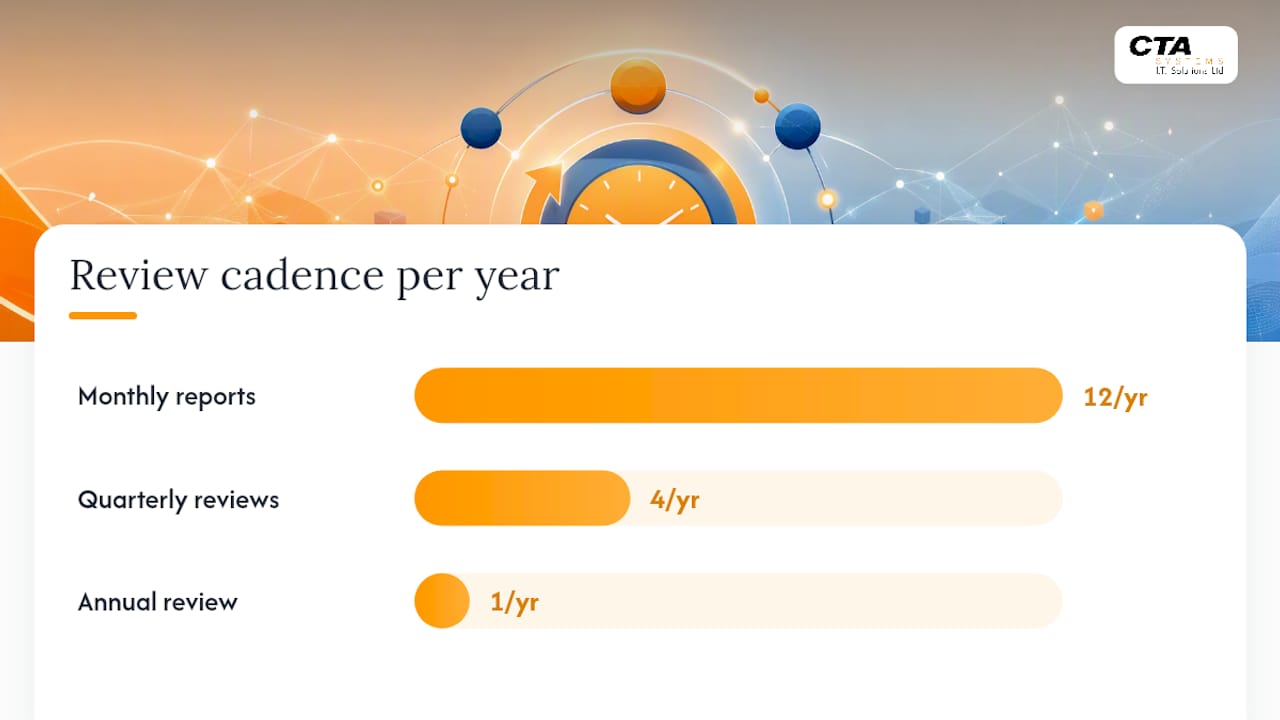
Review cadence matters as much as the metrics themselves. Monthly operational reports, quarterly service reviews, and an annual strategic review give both sides a rhythm for catching drift before it becomes a dispute, and a standing right to inspect underlying data keeps that rhythm honest.
Why proactive monitoring beats reactive SLA management
Most SLA disputes I've seen described in vendor case studies share one root cause: nobody looked at the numbers until something broke. A well-run SLA isn't a document you file away; it's a live feed that a provider should be watching before the customer notices a problem.

That's the practical implication of proactive monitoring done properly. Fixed monthly care plans with clear service schedules, documented restore testing, and named measurement tools give an SME the same operational discipline a much larger organisation would demand, without needing an in-house IT department to police it.
What SMEs should require in practice is straightforward: a service schedule you can actually read, monthly reports with real figures rather than a green dashboard screenshot, and a provider willing to show you a restore test result rather than just claim one happened. The pitfall to watch for is a provider who resists naming their measurement tool or granting data access. That resistance is usually the clearest sign the reporting doesn't exist yet.
— Will
How CTA Systems builds SLA commitments into managed support
An alternative to vague, unmeasured IT support is fixed monthly fees, documented service schedules, and reporting you can actually inspect rather than take on trust. Its managed IT support service bundles helpdesk response, cybersecurity, and infrastructure oversight under one set of terms, backed by remote monitoring that gives you visibility into the same data the engineers use.

If you're managing Microsoft 365 environments, backup and recovery, or day-to-day device support, the questions to put to any provider are the same ones this article has walked through: what's your measurement tool, can I see a sample monthly report, and what happens if a restore test fails. Ctasystems's Care Plans are built around predictable costs and documented service delivery for SMEs that would rather ask those questions once than chase answers every quarter. Get in touch to see a sample service schedule before you commit to anything.
Where to check the detail before you sign
Before finalising or renegotiating an SLA, it's worth reading the primary sources rather than relying on a provider's summary of them.
- ISO/IEC 20000-1 sets the recognised standard for formal service-level management.
- IBM's explainer on SLA components covers service descriptions, tracking, and exclusions in plain terms.
- UK GDPR Article 28 governs the data-processing clauses any SLA involving personal data should reference.
- Infraon's guide to SLA, OLA, and UC differences is useful when mapping vendor contracts against your own targets.
Sources
- Service level agreements
- What Is an SLA (service level agreement)?
- Managed IT Services SLA: 12 Essential Clauses to Avoid Risk
- SLA and OLA: Understanding the key differences | ConnectWise
FAQ
What are examples of IT service level agreements?
Common examples include a helpdesk SLA promising rapid response for critical issues, a hosting SLA guaranteeing high availability with tiered service credits for lower uptime levels, and a backup SLA specifying a short recovery time objective. Each only counts as a real SLA if it names a measurable target, a measurement method, and a consequence for missing it.
What is an SLA in the IT industry?
An SLA in IT is a written agreement between a service provider and a customer that defines the service to be delivered and the measures used to judge performance. It typically covers uptime, response and resolution times, and the remedy owed if those targets are missed.
What are the three types of SLA?
The three most commonly recognised types are customer-level SLAs, service-level SLAs, and multilevel SLAs, though internal SLAs paired with OLAs are increasingly treated as a fourth practical category. Customer-level covers everything one client receives, service-level covers one service across all clients, and multilevel layers corporate, department, and client terms together.
What do SLA priority tiers P1 to P4 mean?
P1 to P4 are priority tiers used to set different response and resolution targets based on how severe an issue is, with P1 typically meaning a critical, business-stopping fault and P4 a low-impact request. A well-structured priority matrix sets separate, specific targets for both response and resolution at each tier rather than one blended figure.
Does Ctasystems offer SLA-backed IT support?
Yes, Ctasystems structures its managed IT support and Care Plans around fixed monthly fees, documented service schedules, and monitoring data the client can review. Specific pricing is available directly from Ctasystems rather than published as a fixed rate.